

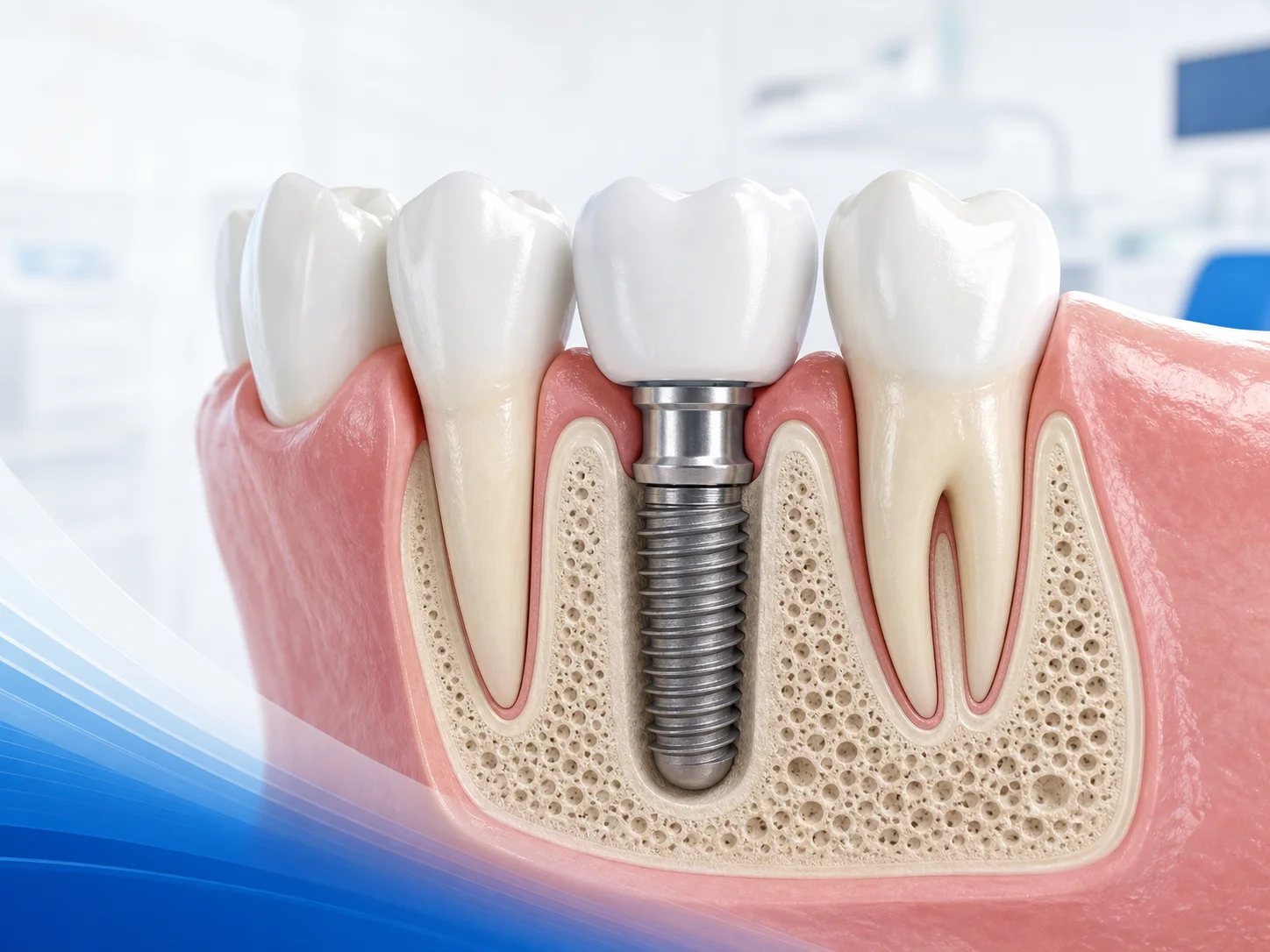
If you are missing a tooth, losing several teeth, or trying to get away from loose dentures, dental implants can feel like the obvious answer. The smarter first step is understanding which implant option actually fits your mouth.
At Astra Dental in Stratford, CT, Dr. Harkirat Sran helps patients compare dental implants, implant bridges, All-on-X dental implants, implant dentures, and staged treatment before deciding what makes the most sense. The goal is not a generic implant plan. The goal is stable teeth that match your bite, bone, smile, health, and budget.
Why dental implant planning should start with the final tooth
A dental implant is the titanium fixture that heals in the jawbone, but the part patients live with every day is the tooth attached to it. That may be a single crown, a bridge, a snap-in denture, or a full-arch set of fixed teeth.
Planning backward from the final tooth helps determine where the implant should go, whether grafting may be needed, what the temporary tooth options are, and how the finished result can be cleaned. A well-placed implant should support the restoration instead of forcing the restoration to work around a poor implant position.
Replacing one missing tooth
For one missing tooth, the implant plan depends on the space, bite pressure, neighboring teeth, gum shape, and bone width. A single-tooth implant can avoid shaving down healthy neighboring teeth for a traditional bridge, but it still has to be planned carefully.
Front teeth usually need extra attention to gum contours and the smile line. Back teeth often require a closer look at chewing forces and space for the crown. If the tooth is failing but still present, the consultation may also compare saving the tooth, removing it and grafting, or placing an implant the same day if the situation is right.
Replacing several missing teeth
When several teeth are missing, patients may not need one implant for every missing tooth. In some cases, two or more implants can support a bridge. In other cases, a partial denture, staged implants, or a different restorative plan may be healthier.
This is where 3D imaging, bite evaluation, gum health, and the condition of nearby teeth matter. A plan that looks cheaper at first can become frustrating if it is hard to clean, feels bulky, overloads the bite, or ignores gum disease.
Full-mouth and All-on-X dental implant options
Patients with many failing teeth or loose dentures may be candidates for same-day teeth or a full-arch implant plan. These cases are more involved because the dentist is planning function, speech, lip support, smile design, hygiene access, and the final material at the same time.
Some full-arch patients may be able to have teeth removed, implants placed, and fixed temporary teeth attached during the same phase of care. Others are better served by grafting, healing, or staged treatment first. Faster is only better when the bone, bite, and overall health make it predictable.
When bone grafting may be part of the plan
Dental implants need enough healthy bone for support. If a tooth has been missing for a long time, if infection damaged the area, or if the jawbone is thin, bone grafting may be recommended before or during implant treatment.
Grafting is not a failure of the plan. It is often the step that makes the plan stronger. The consultation should explain whether grafting is likely, why it is needed, how long healing may take, and whether it changes the temporary tooth options.
What makes Astra Dental different for implant patients
Astra Dental combines implant-focused diagnosis with digital tools and in-house restorative workflows. For selected cases, planning may include 3D imaging, digital scans, photographs, printed models, surgical guide planning, custom temporaries, and lab communication inside the practice.
That matters because implant dentistry is both surgical and restorative. The implant has to heal, but the final tooth has to fit the patient. Keeping those decisions connected can make treatment easier to understand from the first visit.
Local implant questions we hear from Stratford patients
Patients from Stratford, Bridgeport, Fairfield, Trumbull, Shelton, Milford, Monroe, and nearby Fairfield County communities often ask similar questions before starting implant treatment.
- Can I replace a missing tooth without affecting the teeth next to it?
- Do I need bone grafting before getting a dental implant?
- Can a broken tooth be removed and replaced with an implant the same day?
- Are All-on-X teeth fixed or removable?
- How do I clean around implants after treatment?
The best next step
The best implant plan is specific. It should explain what is happening now, what options are realistic, what could change after imaging or extraction, how many visits may be involved, and how the result will be maintained.
If you are comparing implant options, schedule a consultation before trying to decide from search results alone. A clear diagnosis can help you avoid guessing and choose the option that actually fits your mouth.
Astra Dental is located at 2499 Main Street, Unit D, Stratford, CT 06615 and welcomes implant consultations for patients replacing one tooth, several teeth, or a full smile.
How this fits into implant planning at Astra Dental
Patients from Stratford, Bridgeport, Fairfield, Trumbull, Shelton, Milford, and Monroe often come in after hearing several different opinions about implants. The most useful visit starts with diagnosis, not a pre-written plan.
Patients rarely want an implant just because they like the idea of an implant. They want to chew comfortably, avoid a gap, stop worrying about a loose tooth, or understand whether full-mouth replacement is realistic.
Astra Dental starts with diagnosis: the missing or failing tooth, bone support, gum health, bite forces, smile line, health history, and the final tooth design all shape the recommendation.
What an implant-focused visit should cover
A real implant visit should connect the surgical side and the tooth-design side. The implant has to heal in bone, but it also has to support a crown, bridge, denture, or full-arch prosthesis that fits the patient's bite and smile.
Patients should leave understanding the likely sequence, whether a temporary tooth is possible, what the final restoration may be, and what maintenance will look like after treatment.
For more complex implant cases, planning may also include CBCT imaging, intraoral scanning, facial scanning, printed models, surgical guide planning, and in-house temporary or ceramic workflows. The technology is there to make the treatment path clearer, not to rush the patient into one option.
- Review of X-rays or 3D imaging when needed
- Digital planning with scanners, photos, and bite information
- Discussion of bone grafting, gum shape, and healing time
- Comparison of implant and non-implant alternatives
- Clear explanation of temporary and final tooth options
Questions patients should ask
A stronger dental plan usually starts with better questions.
- Am I replacing one tooth, several teeth, or a full arch?
- Do I have enough bone for an implant without grafting?
- Can I have a temporary tooth while the implant heals?
- Which option will be easiest for me to clean and maintain long term?
Details that can change the recommendation
Single-tooth implants, implant bridges, implant dentures, and All-on-X treatment solve different problems and should not be quoted like the same procedure.
Bone grafting, gum shape, sinus position, nerve location, bite pressure, and the condition of neighboring teeth can all change the plan.
For Stratford-area patients, a local implant consultation can also help compare timing, cost, sedation needs, temporary teeth, and follow-up visits before treatment begins.
Common patient questions
Am I replacing one tooth, several teeth, or a full arch?
The answer depends on the exam, X-rays or 3D imaging, bone support, infection history, and the final tooth design. Astra Dental checks these details before recommending a specific implant path.
Do I have enough bone for an implant without grafting?
If this concern affects your case, Dr. Sran will explain whether it changes timing, temporary tooth options, grafting needs, or the final restoration. The goal is to make the tradeoffs easy to understand before treatment begins.
Can I have a temporary tooth while the implant heals?
Implant treatment can be very predictable when the diagnosis, surgical plan, restoration design, and maintenance plan all work together. Skipping one of those steps is where patients can run into surprises.
Which option will be easiest for me to clean and maintain long term?
A consultation is the right time to compare implants with bridges, dentures, partials, root canal treatment, or staged care. Sometimes the best plan is an implant; sometimes the best plan is saving the tooth or preparing the site first.
Long-term success depends on more than placing the implant
Dental implants need maintenance just like natural teeth need maintenance. The bite, cleaning access, gum health, medical history, and design of the restoration all affect how the result holds up over time.
That is why Astra Dental talks about the final tooth early. A well-planned implant should be placed where the final restoration needs support, not just where bone happens to be available.
When to schedule an implant consultation
It is worth scheduling a consultation if a tooth is missing, loose, cracked below the gumline, repeatedly infected, uncomfortable under a denture, or no longer restorable. The sooner the area is evaluated, the easier it is to understand bone support, temporary tooth options, and whether grafting may be needed.
Patients do not need to know the perfect treatment before calling. The purpose of the visit is to compare options and build a plan around health, comfort, timing, appearance, and budget.
Helpful next pages
Patients comparing options can also review Dental Implants, All-on-X Dental Implants, Same Day Teeth, Bone Grafting, Before & After Gallery.